
 Image 1 of 5
 Image 2 of 5
 Image 3 of 5
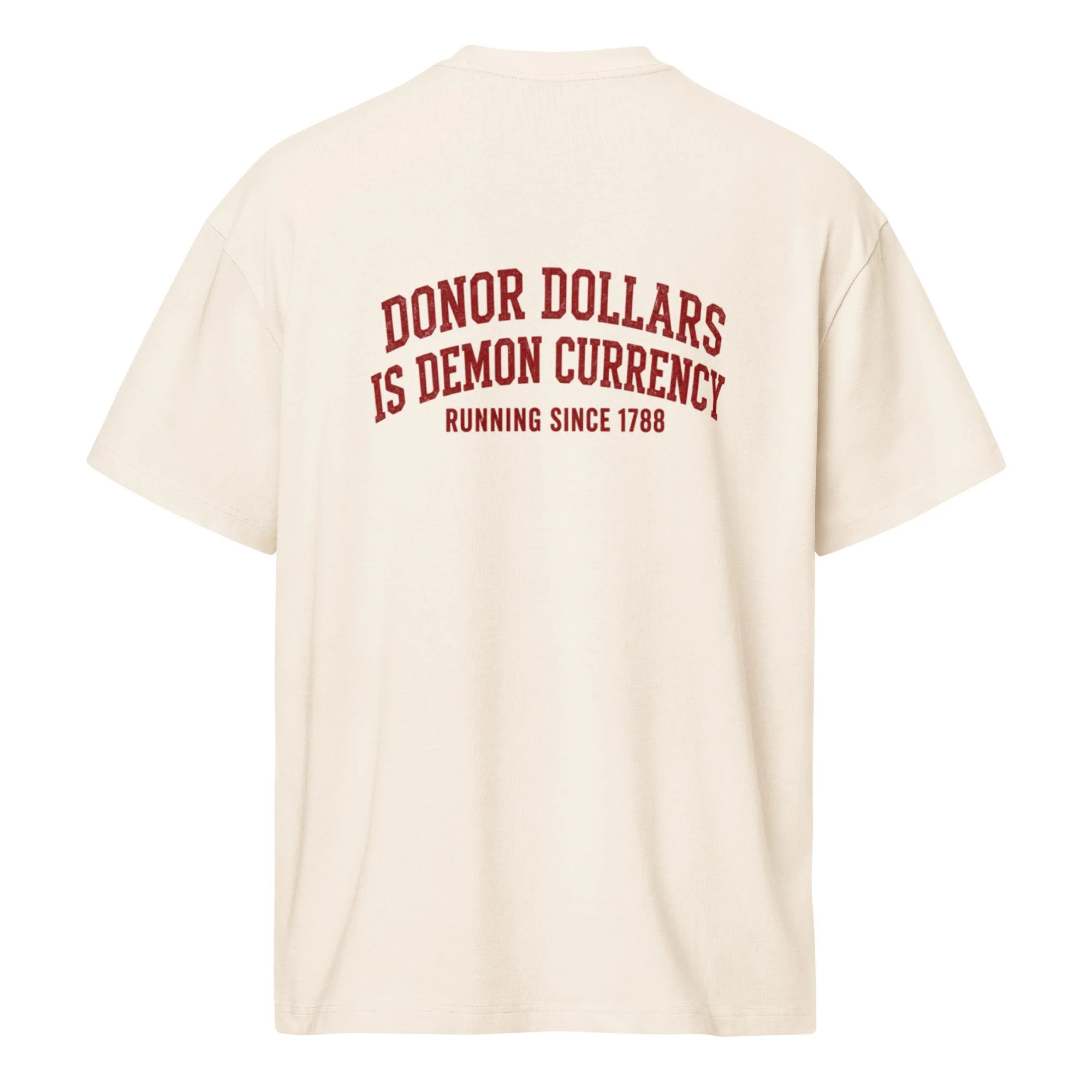 Image 4 of 5
 Image 5 of 5
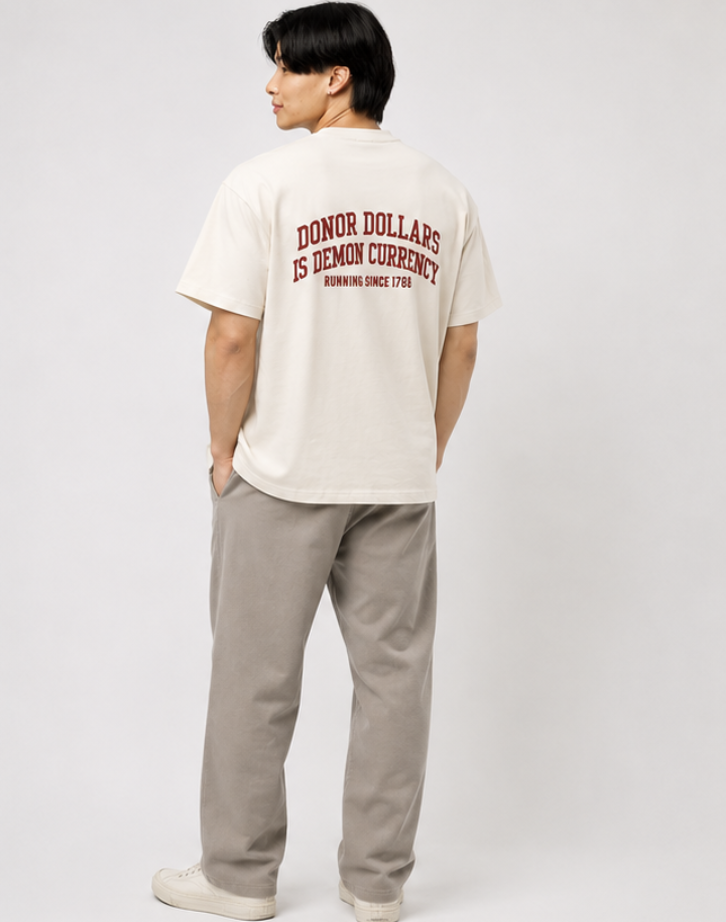
Demon Currency Tee
Money has always influenced politics.
Long before Super PACs, billionaires, billion-dollar election cycles, television advertisements and fundraising texts, American politics depended on people with the resources to spread ideas.
In the early Republic, political influence traveled through newspapers, pamphlets, printers, correspondence, political clubs, personal relationships and wealthy supporters.
There was no Federal Election Commission.
There were no federal contribution limits.
There were no Super PACs.
But there were people willing to spend money to shape political outcomes.
The technology changed. The money didn't.
This shirt asks a simple question:
Who is really speaking…the candidate, or the people financing the campaign?
Whether you believe political spending protects free speech or gives wealthy interests disproportionate influence, the tension between money, speech, power and representation has followed American politics almost from the beginning.
WHY “RUNNING SINCE 1788”?
The presidential election of 1788–89 was the first presidential election in United States history.
George Washington did not campaign for president in anything resembling the modern sense. There were no Washington campaign rallies, television advertisements, fundraising emails or Super PACs.
But the new Constitution created something that would eventually become extraordinarily expensive: a national competition for political power.
Newspapers, pamphlets, correspondence and personal networks became critical tools for influencing political opinion.
As political parties developed in the 1790s, wealthy merchants, publishers, printers and political allies increasingly played roles in disseminating political arguments.
The American campaign machine was beginning to take shape.
And by the nineteenth century, the money behind that machine was becoming impossible to ignore.
1896: WHEN BIG MONEY GOT REALLY BIG
The presidential election of 1896 is one of the great turning points in American campaign finance.
Republican William McKinley's political strategist Mark Hanna built a massive fundraising operation by approaching America's industrial and financial elite.
Hanna reportedly raised roughly $3.5 million for McKinley's campaign, an extraordinary amount of money at the time.
Some individual corporate interests contributed enormous sums.
Standard Oil reportedly contributed about $250,000.
Financier J.P. Morgan reportedly contributed another $250,000.
The money helped finance organizers, speakers, campaign materials and millions upon millions of pieces of political literature.
America was discovering just how powerful a well-financed national campaign could become.
And the public began asking an uncomfortable question:
If enormous corporations and financiers are paying to elect politicians, who will those politicians ultimately answer to?
1907: CONGRESS TRIES TO CLOSE THE CORPORATE CHECKBOOK
Those concerns eventually produced federal legislation.
In 1907, President Theodore Roosevelt signed the Tillman Act, prohibiting corporations and national banks from making direct monetary contributions in connection with federal elections.
It represented one of America's earliest major attempts to separate corporate treasury money from candidates.
The reasoning was straightforward:
Allowing a corporation to place enormous sums directly into the hands of a candidate could create corruption or at least the appearance that political access and influence were being purchased.
But restricting organizations didn't remove money from politics.
It changed the way political money was organized.
1943: AMERICA GETS ITS FIRST PAC
During World War II, organized labor faced new restrictions on how union money could be used politically.
In July 1943, the Congress of Industrial Organizations CIO, created the CIO Political Action Committee, generally regarded as the first major modern PAC.
CIO president Philip Murray oversaw the organization when it was established.
But the man chosen to lead the new political operation was Sidney Hillman.
Hillman was one of the most powerful labor leaders in America.
He headed the Amalgamated Clothing Workers of America, served as a CIO vice president and had developed a close political relationship with President Franklin D. Roosevelt.
And the PAC had a very practical political objective:
mobilize voters and organized labor behind Roosevelt and other labor-friendly candidates in the 1944 election.
But the origin story gets even more interesting.
John Abt, who later served as counsel to the CIO-PAC and acknowledged having been a member of the Communist Party USA, later claimed that Communist Party leader Eugene Dennis had suggested creating such a political committee.
According to Abt's later account, the proposal was taken to labor leaders including Philip Murray and Sidney Hillman, who embraced the concept.
The CIO formally created the organization and Hillman led it.
But Abt's account provides a fascinating and controversial piece of the PAC's origin story — and a reminder that organized political money has always involved coalitions, competing interests and people attempting to find new ways of influencing elections.
The PAC had arrived.
And it wasn't going away.
THE GOVERNMENT BUILDS A CAMPAIGN-FINANCE SYSTEM
By the 1970s, campaign finance had become important enough that Congress constructed an extensive federal regulatory system around it.
The Federal Election Campaign Act and major amendments enacted in the 1970s established contribution limits, disclosure requirements and eventually the Federal Election Commission.
Washington was now attempting to answer an extraordinarily difficult question:
How do you prevent people from buying politicians without preventing people from spending money to express political ideas?
That question went all the way to the Supreme Court.
MONEY VS. SPEECH
In Buckley v. Valeo (1976), the Supreme Court drew a distinction that still shapes American elections.
Giving money directly to a candidate could be limited in order to combat corruption or the appearance of corruption.
But spending money independently to communicate a political message implicated the First Amendment much more directly.
That distinction is enormously important.
Because the government isn't simply regulating money.
Political advertising costs money. Printing pamphlets costs money. Running television commercials costs money. Building websites costs money. Hiring organizers costs money. Reaching millions of voters costs money.
So restricting political expenditures can also restrict someone's ability to distribute political speech.
And that is where campaign-finance law becomes complicated.
WHY CAN'T A BILLIONAIRE JUST GIVE A CANDIDATE $10 MILLION?
Because federal law limits direct contributions to candidates.
For the 2025–2026 federal election cycle, an individual may contribute $3,500 per election to a federal candidate's committee.
A qualifying multicandidate PAC generally may contribute $5,000 per election to a candidate.
Those limits exist largely because direct contributions create the clearest potential for corruption or political indebtedness.
If one person could personally finance half of a politician's campaign by writing a check directly to that politician, voters could reasonably wonder:
Who does that politician work for now?
But there's another side to the equation.
THE SUPER PAC CHANGES EVERYTHING
A wealthy individual cannot simply write a presidential candidate's campaign a $20 million check.
But that person can potentially spend enormous amounts independently supporting that candidate.
That's where the modern Super PAC enters the story.
Super PACs, technically independent-expenditure-only political committees can accept unlimited contributions from individuals, corporations, labor organizations and other groups.
The catch is important:
That unlimited money cannot simply be handed to the candidate.
Super PACs cannot make direct contributions to candidates and are supposed to make their expenditures independently rather than coordinating them with the candidate's campaign.
So modern campaign-finance law has created a strange reality.
A billionaire is limited to a few thousand dollars when writing a check directly to a federal candidate.
But that same billionaire may spend millions through independent political activity supporting the candidate.
Why?
Because American law attempts to distinguish between:
money given to a politician and money spent expressing a political opinion.
One raises an obvious corruption concern.
The other raises an obvious free-speech concern.
And more than two centuries after America's first presidential election, we still haven't completely figured out where one ends and the other begins.
SO WHO REALLY HAS THE LOUDEST VOICE?
That's the question behind the shirt. Republicans have wealthy donors. Democrats have wealthy donors. Corporations have political interests. Labor unions have political interests. Advocacy organizations have political interests. Billionaires have political interests. PACs have political interests.
And every one of them has a constitutional right to participate in American political life while Americans simultaneously have an interest in preventing their representatives from simply being purchased by the highest bidder.
That tension isn't new.
We've spent more than a century passing laws, creating committees, challenging those laws in court, rewriting the rules and inventing new political organizations to answer essentially the same question:
Can representatives truly serve the people when winning office depends on people willing to finance the race?
Maybe money is speech. Maybe money buys influence. Maybe, in American politics, it's always been a little bit of both.
Some call it campaign finance. Some call it political speech. Some call it influence.
We simply call it history.
Money has always influenced politics.
Long before Super PACs, billionaires, billion-dollar election cycles, television advertisements and fundraising texts, American politics depended on people with the resources to spread ideas.
In the early Republic, political influence traveled through newspapers, pamphlets, printers, correspondence, political clubs, personal relationships and wealthy supporters.
There was no Federal Election Commission.
There were no federal contribution limits.
There were no Super PACs.
But there were people willing to spend money to shape political outcomes.
The technology changed. The money didn't.
This shirt asks a simple question:
Who is really speaking…the candidate, or the people financing the campaign?
Whether you believe political spending protects free speech or gives wealthy interests disproportionate influence, the tension between money, speech, power and representation has followed American politics almost from the beginning.
WHY “RUNNING SINCE 1788”?
The presidential election of 1788–89 was the first presidential election in United States history.
George Washington did not campaign for president in anything resembling the modern sense. There were no Washington campaign rallies, television advertisements, fundraising emails or Super PACs.
But the new Constitution created something that would eventually become extraordinarily expensive: a national competition for political power.
Newspapers, pamphlets, correspondence and personal networks became critical tools for influencing political opinion.
As political parties developed in the 1790s, wealthy merchants, publishers, printers and political allies increasingly played roles in disseminating political arguments.
The American campaign machine was beginning to take shape.
And by the nineteenth century, the money behind that machine was becoming impossible to ignore.
1896: WHEN BIG MONEY GOT REALLY BIG
The presidential election of 1896 is one of the great turning points in American campaign finance.
Republican William McKinley's political strategist Mark Hanna built a massive fundraising operation by approaching America's industrial and financial elite.
Hanna reportedly raised roughly $3.5 million for McKinley's campaign, an extraordinary amount of money at the time.
Some individual corporate interests contributed enormous sums.
Standard Oil reportedly contributed about $250,000.
Financier J.P. Morgan reportedly contributed another $250,000.
The money helped finance organizers, speakers, campaign materials and millions upon millions of pieces of political literature.
America was discovering just how powerful a well-financed national campaign could become.
And the public began asking an uncomfortable question:
If enormous corporations and financiers are paying to elect politicians, who will those politicians ultimately answer to?
1907: CONGRESS TRIES TO CLOSE THE CORPORATE CHECKBOOK
Those concerns eventually produced federal legislation.
In 1907, President Theodore Roosevelt signed the Tillman Act, prohibiting corporations and national banks from making direct monetary contributions in connection with federal elections.
It represented one of America's earliest major attempts to separate corporate treasury money from candidates.
The reasoning was straightforward:
Allowing a corporation to place enormous sums directly into the hands of a candidate could create corruption or at least the appearance that political access and influence were being purchased.
But restricting organizations didn't remove money from politics.
It changed the way political money was organized.
1943: AMERICA GETS ITS FIRST PAC
During World War II, organized labor faced new restrictions on how union money could be used politically.
In July 1943, the Congress of Industrial Organizations CIO, created the CIO Political Action Committee, generally regarded as the first major modern PAC.
CIO president Philip Murray oversaw the organization when it was established.
But the man chosen to lead the new political operation was Sidney Hillman.
Hillman was one of the most powerful labor leaders in America.
He headed the Amalgamated Clothing Workers of America, served as a CIO vice president and had developed a close political relationship with President Franklin D. Roosevelt.
And the PAC had a very practical political objective:
mobilize voters and organized labor behind Roosevelt and other labor-friendly candidates in the 1944 election.
But the origin story gets even more interesting.
John Abt, who later served as counsel to the CIO-PAC and acknowledged having been a member of the Communist Party USA, later claimed that Communist Party leader Eugene Dennis had suggested creating such a political committee.
According to Abt's later account, the proposal was taken to labor leaders including Philip Murray and Sidney Hillman, who embraced the concept.
The CIO formally created the organization and Hillman led it.
But Abt's account provides a fascinating and controversial piece of the PAC's origin story — and a reminder that organized political money has always involved coalitions, competing interests and people attempting to find new ways of influencing elections.
The PAC had arrived.
And it wasn't going away.
THE GOVERNMENT BUILDS A CAMPAIGN-FINANCE SYSTEM
By the 1970s, campaign finance had become important enough that Congress constructed an extensive federal regulatory system around it.
The Federal Election Campaign Act and major amendments enacted in the 1970s established contribution limits, disclosure requirements and eventually the Federal Election Commission.
Washington was now attempting to answer an extraordinarily difficult question:
How do you prevent people from buying politicians without preventing people from spending money to express political ideas?
That question went all the way to the Supreme Court.
MONEY VS. SPEECH
In Buckley v. Valeo (1976), the Supreme Court drew a distinction that still shapes American elections.
Giving money directly to a candidate could be limited in order to combat corruption or the appearance of corruption.
But spending money independently to communicate a political message implicated the First Amendment much more directly.
That distinction is enormously important.
Because the government isn't simply regulating money.
Political advertising costs money. Printing pamphlets costs money. Running television commercials costs money. Building websites costs money. Hiring organizers costs money. Reaching millions of voters costs money.
So restricting political expenditures can also restrict someone's ability to distribute political speech.
And that is where campaign-finance law becomes complicated.
WHY CAN'T A BILLIONAIRE JUST GIVE A CANDIDATE $10 MILLION?
Because federal law limits direct contributions to candidates.
For the 2025–2026 federal election cycle, an individual may contribute $3,500 per election to a federal candidate's committee.
A qualifying multicandidate PAC generally may contribute $5,000 per election to a candidate.
Those limits exist largely because direct contributions create the clearest potential for corruption or political indebtedness.
If one person could personally finance half of a politician's campaign by writing a check directly to that politician, voters could reasonably wonder:
Who does that politician work for now?
But there's another side to the equation.
THE SUPER PAC CHANGES EVERYTHING
A wealthy individual cannot simply write a presidential candidate's campaign a $20 million check.
But that person can potentially spend enormous amounts independently supporting that candidate.
That's where the modern Super PAC enters the story.
Super PACs, technically independent-expenditure-only political committees can accept unlimited contributions from individuals, corporations, labor organizations and other groups.
The catch is important:
That unlimited money cannot simply be handed to the candidate.
Super PACs cannot make direct contributions to candidates and are supposed to make their expenditures independently rather than coordinating them with the candidate's campaign.
So modern campaign-finance law has created a strange reality.
A billionaire is limited to a few thousand dollars when writing a check directly to a federal candidate.
But that same billionaire may spend millions through independent political activity supporting the candidate.
Why?
Because American law attempts to distinguish between:
money given to a politician and money spent expressing a political opinion.
One raises an obvious corruption concern.
The other raises an obvious free-speech concern.
And more than two centuries after America's first presidential election, we still haven't completely figured out where one ends and the other begins.
SO WHO REALLY HAS THE LOUDEST VOICE?
That's the question behind the shirt. Republicans have wealthy donors. Democrats have wealthy donors. Corporations have political interests. Labor unions have political interests. Advocacy organizations have political interests. Billionaires have political interests. PACs have political interests.
And every one of them has a constitutional right to participate in American political life while Americans simultaneously have an interest in preventing their representatives from simply being purchased by the highest bidder.
That tension isn't new.
We've spent more than a century passing laws, creating committees, challenging those laws in court, rewriting the rules and inventing new political organizations to answer essentially the same question:
Can representatives truly serve the people when winning office depends on people willing to finance the race?
Maybe money is speech. Maybe money buys influence. Maybe, in American politics, it's always been a little bit of both.
Some call it campaign finance. Some call it political speech. Some call it influence.
We simply call it history.